Why participation matters
Across European cities, marginalized urban areas face persistent challenges—poor infrastructure, limited access to services, and social exclusion. Traditional top-down regeneration often overlooks these realities, leading to projects that fail to reflect the daily lives of residents. Genuine participation can change this. When people have the chance to shape their environment, democracy becomes tangible and cities become more inclusive.
A pilot project: voting for the future of a park
In Bucharest, a pilot project brought this principle to life through the regeneration of Cinematograf Park, a neglected green space situated between two marginalized neighborhoods. Instead of presenting residents with ready-made plans, the process invited them to decide for themselves—through a community voting system designed on democratic principles.


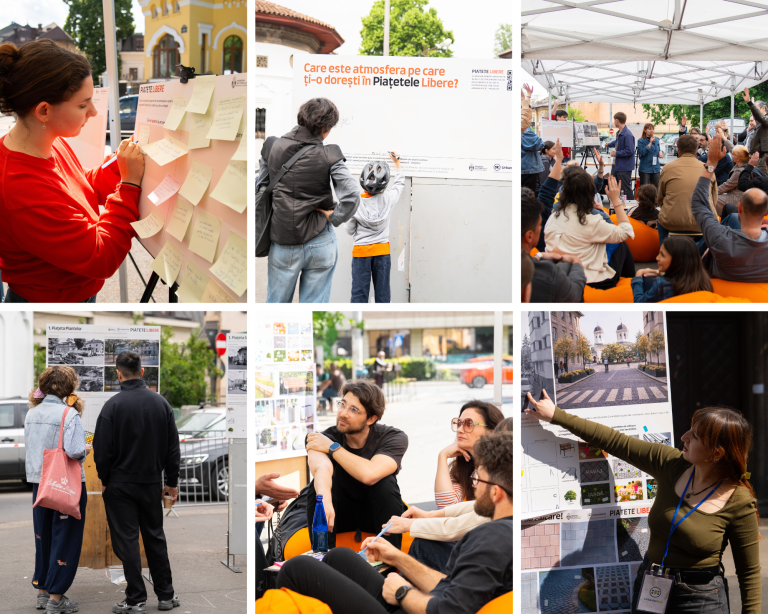
More than 560 people responded to surveys, while local workshops used illustrated ballots that allowed residents to vote on both functions and aesthetics. Should the park have playgrounds, sports fields, shaded green areas, picnic meadows, or social piazzettas? Should these spaces look formal, naturalized, or mixed? The ballot box became a tool of urban democracy, giving residents equal voice regardless of age, education, or digital access.
The results were clear: people wanted safe and adaptable playgrounds, shaded areas, naturalized landscapes with water, and basic facilities such as lighting, toilets, and drinking fountains. They also supported piazzettas as social hubs, while rejecting proposals for community gardens or greenhouses, which they felt would be difficult to maintain.
From practice to methodology
This experiment was not isolated. It is part of a broader effort to design a systematic methodology for community involvement in urban regeneration. The framework, developed under the Livable Region Program 2021–2027, sets out ten steps for involving marginalized communities throughout the project cycle—from strategic planning to participatory monitoring. The Cinematograf Park pilot specifically tested steps six and seven, proving that participation can shape both the concept and the technical documentation of projects.
Looking ahead
The pilot shows that democratic tools such as voting can bring marginalized voices to the center of urban transformation. Participation becomes not a formality, but a foundation for trust, ownership, and resilience. For cities aiming to be livable and fair, inclusive governance is no longer optional—it is essential.
This initiative was carried out within the Bucharest-Ilfov Livable Region Program 2021–2027, developed by the Regional Development Agency (ADR-BI) in partnership with the World Bank. UrbanizeHub contributed to the pilot project as part of its ongoing expertise in participatory processes, built since 2020.